Madness Rules the Hour by Paul Starobin
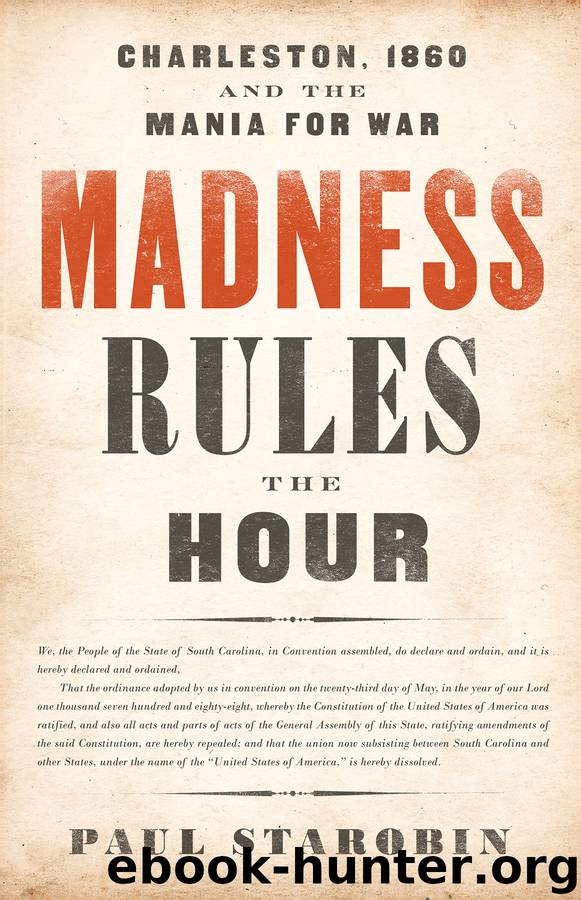
Author:Paul Starobin
Language: eng
Format: epub
Publisher: PublicAffairs
Published: 2017-04-10T16:00:00+00:00
Chapter Twenty-One
“GOD HAVE MERCY ON MY COUNTRY”
It was one thing to laugh at a country bumpkin strutting down Meeting Street with a blue cockade pinned to his wide-brimmed hat and a worn rifle in his sweaty grip. In contrast, a man of the Washington Light Infantry commanded respect in his expensively tailored, dark-blue frock with black-silk trim and brass-ball buttons and his red-striped trousers. The militia took its name from George Washington, whose birthday the men heartily celebrated on February 22 with a banquet attended by the city’s notables. Founded in 1807, the rolls featured eminent Charleston names like Lowndes, Ravenel, and Gilchrist. An honor guard of the infantry greeted Lafayette, in French, on his visit to the town in 1825. Infantrymen fought the Seminole Indians in Florida in the 1830s and marched into Mexico City as part of the Palmetto Regiment in the 1840s. Their motto was “Virtue and Valor” and their crest a winged angel with horn in mouth, triumphantly soaring through the clouds.
From the start of 1860, the Washington Light Infantry had been a visible presence drilling and parading on the streets of Charleston. In May, its members had marched off to the train station for a visit to their rural campsite and were later welcomed home with banners suspended across Meeting at Hibernian Hall. Two companies of 144 men in all had turned out for a Fourth of July procession through downtown Charleston.
On the evening of Saturday, October 20, with the election nearly two weeks away, the men assembled to consider “the threatening aspect of affairs and the necessity of preparing to meet the emergency.” The commanding officer, Captain Charles Henry Simonton—a thirty-one-year-old native of Charleston, a practicing lawyer in town, and an elected member of the state House of Representatives—proposed that the unit undertake preparations “to take the field at a moment’s warning” and even to go into battle, if need be, against Union forces. The men agreed and unanimously adopted a resolution offered by Sergeant William Ashmead Courtenay—a twenty-nine-year-old Charleston businessman and future mayor—to make one hundred men of the Washington Light Infantry immediately available to the governor of South Carolina as Minute Men, with a pledge to raise the number to two hundred, if desired, to form a battalion of light infantry. In Columbia, Governor William Henry Gist accepted the offer.
The Charleston Light Dragoons, a mounted regiment, was equal in prestige and costume to the Washington Light Infantry. Its men wore helmets of brass-trimmed, black patent leather with a large plume of white horse hair and bottle-green jackets trimmed with red cashmere. With origins predating the Revolution, this militia also drew from old, upper-class Anglo and Huguenot families—names like Manigault, Heyward, Middleton, and Huger. Its members tended to be known as much for their capacities for quaffing champagne as for their battlefield exploits, but by October their blood was up with an impatient desire to confront the North. One member of the “Drags,” as the Light Dragoons were called, William Lee Trenholm, wrote to a friend of the “improving” election prospects of the Breckinridge ticket.
Download
This site does not store any files on its server. We only index and link to content provided by other sites. Please contact the content providers to delete copyright contents if any and email us, we'll remove relevant links or contents immediately.
| Africa | Americas |
| Arctic & Antarctica | Asia |
| Australia & Oceania | Europe |
| Middle East | Russia |
| United States | World |
| Ancient Civilizations | Military |
| Historical Study & Educational Resources |
Cat's cradle by Kurt Vonnegut(15559)
Pimp by Iceberg Slim(14805)
4 3 2 1: A Novel by Paul Auster(12627)
Underground: A Human History of the Worlds Beneath Our Feet by Will Hunt(12237)
The Radium Girls by Kate Moore(12189)
Wiseguy by Nicholas Pileggi(5945)
The Fire Next Time by James Baldwin(5592)
Perfect Rhythm by Jae(5549)
American History Stories, Volume III (Yesterday's Classics) by Pratt Mara L(5389)
Paper Towns by Green John(5331)
Pale Blue Dot by Carl Sagan(5169)
A Higher Loyalty: Truth, Lies, and Leadership by James Comey(5091)
The Doomsday Machine by Daniel Ellsberg(4627)
The Mayflower and the Pilgrims' New World by Nathaniel Philbrick(4608)
Killers of the Flower Moon: The Osage Murders and the Birth of the FBI by David Grann(4557)
The Sympathizer by Viet Thanh Nguyen(4525)
Too Much and Not the Mood by Durga Chew-Bose(4457)
The Borden Murders by Sarah Miller(4450)
Sticky Fingers by Joe Hagan(4321)
